
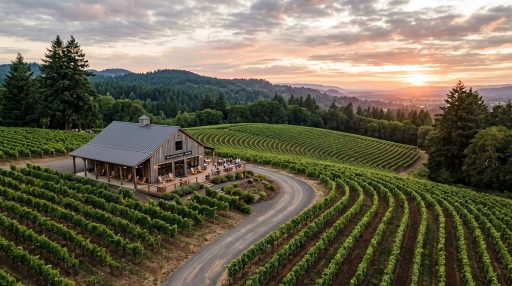
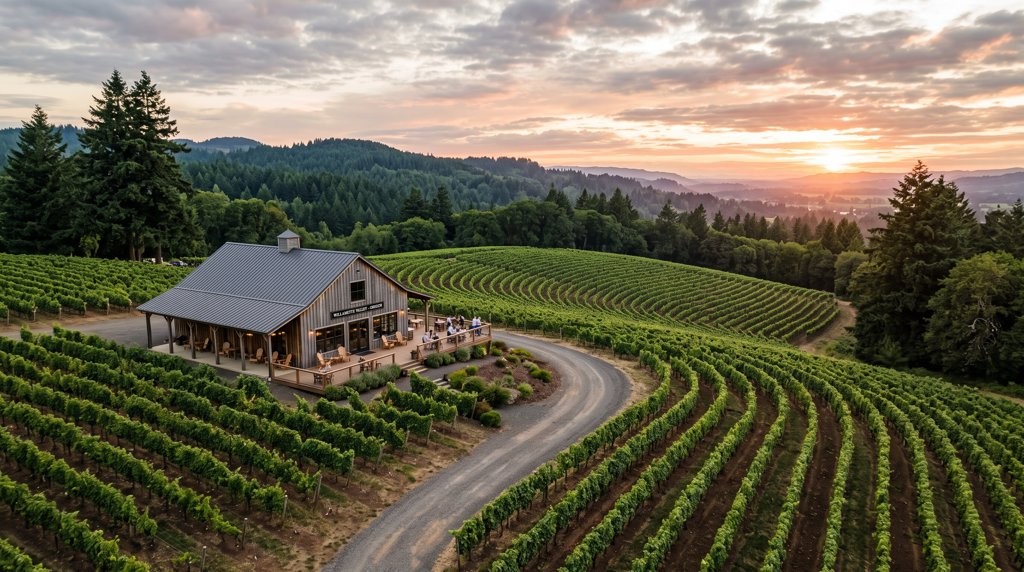
The McMinnville AVA sits in the Coast Range foothills just west of its namesake town, and while it’s smaller and less famous than some of its neighbors in Oregon’s Willamette Valley, the wine coming out of it punches well above its size. We’re working our way through the wineries here one at a time and building this page out as we go.
Region Overview | Wineries We’ve Visited | The McMinnville AVA | Visiting Tips | FAQ | Own a McMinnville Winery?

Region Overview
McMinnville sits about 40 miles southwest of Portland, and the AVA itself lies just west of town, tucked into the eastern slopes of Oregon’s Coast Range. What makes this pocket of the Willamette Valley distinctive is geology as much as geography: the soils here sit on the Nestucca Formation, a thick bed of uplifted marine sedimentary rock that’s genuinely different from the volcanic soils found elsewhere in the valley. That, combined with a rain shadow from the Coast Range and drying winds funneling through the nearby Van Duzer Corridor, gives McMinnville’s vineyards a distinct growing environment from their neighbors just a few miles east.
Compared to some of the bigger-name Willamette Valley sub-AVAs, McMinnville stays small and personal — a handful of wineries, several of them genuinely hands-on, small-production operations rather than big tasting-room destinations.
Wineries We’ve Visited
La Bête Wines
McMinnville, OR — A small, largely one-man winery run by Burgundy-trained winemaker John Eliassen, producing non-interventionist, terroir-focused Pinot Noir alongside rare Burgundian whites like Aligoté and Melon de Bourgogne. Open to the public on Thanksgiving and Memorial Day weekends, and by appointment otherwise.
Read our full La Bête Wines review →
More McMinnville wineries coming soon as we visit them.
The McMinnville AVA
The McMinnville AVA was established in 2005 as a nested sub-appellation within the larger Willamette Valley AVA, covering roughly 40,500 acres in Yamhill County. It’s one of the few American AVAs whose boundary is defined purely by elevation — only land between 200 and 1,000 feet above sea level qualifies, since that’s the band where the area’s distinctive marine sedimentary soils are exposed. Only around 750 acres within that boundary are actually planted with vines, spread across a small number of vineyards and wineries — a genuinely boutique corner of Willamette Valley wine country.
Pinot Noir dominates here, alongside Chardonnay, Pinot Gris, Riesling, and Pinot Blanc — cooler-climate varieties suited to the region’s marine-influenced soils and rain-shadow climate.
Visiting McMinnville Wineries
Check hours before you go: Several wineries in this AVA are small, hands-on operations without daily public hours — some open only on specific weekends or by appointment.
Call ahead for the smaller producers: This isn’t a region of big tasting-room destinations. A quick call or email often gets you a far better, more personal visit than showing up unannounced.
Combine it with nearby AVAs: McMinnville sits close to Yamhill-Carlton, Dundee Hills, and other well-known Willamette Valley sub-regions, making it easy to build a fuller day of tasting around it.
Ask about direct ordering: Some of the smaller wineries here focus more on mail order and select retailers than on-site sales — worth asking if a visit isn’t practical.
FAQ
What is the McMinnville AVA?
A federally recognized American Viticultural Area established in 2005, nested within the larger Willamette Valley AVA. It covers land in the Coast Range foothills west of McMinnville, Oregon, defined specifically by elevation — between 200 and 1,000 feet.
What grapes grow best in the McMinnville AVA?
Pinot Noir leads, followed by Chardonnay, Pinot Gris, Riesling, and Pinot Blanc — all well-suited to the area’s marine sedimentary soils and rain-shadow climate.
How is McMinnville different from other Willamette Valley AVAs?
Its soils sit on the Nestucca Formation, a distinct uplifted marine sedimentary bedrock, rather than the volcanic soils found in many neighboring sub-AVAs. It’s also notably small and boutique, with far fewer planted acres than better-known neighbors like Dundee Hills or Yamhill-Carlton.
Is McMinnville close to Portland?
Yes — about 40 miles southwest, making it an easy day trip.
Own a McMinnville Winery?
We’re actively visiting wineries in this region. If you run a winery in the McMinnville AVA, get in touch — we’d love to come taste what you’re pouring.
Looking for wine delivered instead? Browse our full Best Wine Clubs guide to find your perfect match.